After more than 20 years serving buyers from our Los Angeles warehouse, we’re excited to bring the full Via Trading buying experience to the Southeast. Our new Tampa facility is now open, stocked with liquidation pallets, and ready for buyers who want to see the merchandise before they buy.
For resellers, bin store owners, flea market vendors, exporters, discount store owners, and online sellers across Florida and the Southeast, this changes the game.
You no longer have to rely only on photos, descriptions, or long-distance shipping from California. Now you can walk the floor in Tampa, inspect pallets in person, review manifests, talk with our team, and make better buying decisions before you spend a dollar.
If you’ve bought from Via Trading before, you already know what makes us different.
We believe buyers should have the opportunity to understand what they are buying. At our Tampa warehouse, you can visit in person, walk through available inventory, open boxes, check product condition, review manifests when available, and get guidance from an experienced team that understands the liquidation business.
That hands-on experience is especially important in the wholesale liquidation industry, where every load can be different.
Inside the Tampa facility, you’ll find pallets and truckloads of merchandise across a variety of categories, including customer returns, overstock merchandise, shelf pulls, closeouts, housewares, apparel, handbags, furniture, general merchandise, and more.
New loads arrive regularly, which means inventory changes often. Whether you’re looking for one pallet to test a new category or multiple truckloads to keep your store stocked, the Tampa team can help you find options that fit your business model.
For years, many buyers in Florida, Georgia, the Carolinas, Alabama, and other parts of the Southeast have sourced from Via Trading in California.
That worked — but freight was always part of the equation.
With Via Trading Tampa now open, Southeast buyers have a much more convenient option. You can pick up locally, arrange regional shipping, or source inventory from Tampa instead of shipping everything across the country.
For many buyers, that can mean lower freight costs, faster turnaround, better access to inventory, more flexibility when buying pallets or truckloads, and better margins on certain loads.
In liquidation, freight can make or break a deal. Having inventory on the ground in Tampa gives buyers in the region a better way to source merchandise and move product faster.
One of the biggest advantages of buying from Via Trading Tampa is simple: you can visit the warehouse in person.
No appointment is needed.
You can stop by, walk the floor, see what is available, and talk with our team about what type of merchandise makes sense for your business.
This is ideal if you are opening or running a bin store, selling at flea markets or swap meets, exporting merchandise internationally, selling online, supplying a discount store, buying pallets for the first time, or scaling from pallets to truckloads.
If you are new to liquidation, visiting the warehouse is one of the best ways to understand how the business works. If you are an experienced buyer, it gives you the chance to move faster, compare loads, and source inventory with more confidence.
Via Trading offers access to different types of liquidation merchandise, including customer returns, shelf pulls, overstock, closeouts, and other wholesale opportunities.
Each condition is different, and understanding those differences matters. Before buying, it helps to know what customer returns, overstock, shelf pulls, and closeout merchandise actually mean.
At the Tampa warehouse, availability will change as new loads arrive, but buyers can expect opportunities across categories such as customer returns, overstock merchandise, shelf pulls, closeout merchandise, housewares, apparel, handbags, furniture, general merchandise, seasonal merchandise, health and beauty, tools and hardware, home goods, and more.
Every buyer is different.
Some buyers want to start small with one pallet. Others are looking for LTL loads, mixed pallets, manifested loads, or full truckloads. That is why Via Trading gives buyers different ways to source merchandise depending on their budget, experience, and resale model.
If you are ready to explore larger buying opportunities, you can browse available manifested truckloads or use the Load Center to search and filter available listings.
The Load Center is especially useful because it allows buyers to review available case lots, pallets, LTLs, truckloads, manifest summaries, product conditions, categories, FOB points, pricing, and other details before making a purchasing decision.
Via Trading Tampa is open now and ready for buyers across Florida and the Southeast.
No appointment is needed. Stop by, walk the floor, and see what is currently in stock.
Our Tampa team is ready to help you find the right loads for your business, whether you’re buying your first pallet or sourcing truckloads every week.
Now Open
1201 Old Hopewell Road, Suite 1
Tampa, FL 33619
Phone: 877-202-3616
Website: www.viatrading.com
You’re Invited
Saturday, August 1, 2026
1201 Old Hopewell Road, Suite 1, Tampa, FL 33619
We are also celebrating the official Grand Opening of Via Trading Tampa on Saturday, August 1, 2026, and you are invited.
This is a great opportunity to tour the facility, meet the Via Trading team, browse current inventory, and connect with other buyers from across Florida and the Southeast.
Whether you are a longtime Via Trading customer or you have never bought a pallet of liquidation merchandise before, the Grand Opening is the perfect time to see how the process works.
Come walk the warehouse, ask questions, look at available pallets, and discover what wholesale liquidation can do for your business.
Mark your calendar — and bring a truck.
If you cannot make it to the warehouse, you can still access Tampa inventory online.
Via Trading Tampa merchandise is also available through the website, including Tampa online auctions and available loads that can be shipped or prepared for pickup.
You can browse current inventory anytime through the Via Trading website, the All Products page, or the Load Center.
Since 2002, Via Trading has helped resellers, exporters, store owners, online sellers, and wholesale buyers source liquidation merchandise for resale.
The company has served thousands of buyers across the United States and around the world, and Tampa is an important step in making wholesale liquidation merchandise more accessible to buyers across the Southeast.
For Florida and Southeast buyers, the wait is over.
Via Trading Tampa is open now.
Come visit, walk the floor, inspect the merchandise, and find the right loads for your business.
Visit us at 1201 Old Hopewell Road, Suite 1, Tampa, FL 33619, call 877-202-3616, or browse available loads online.
Our Buyer Tools section features a series of widgets and calculators specifically developed to help you perform various useful calculations including calculating your potential revenues, profits and more! Each widget comes with detailed instructions on its purpose and functions along with two examples of how to use it. Feel free to call or email us with any questions, feedback or suggestions!
This allows you to convert one currency to another using the current exchange rate. Via Trading accepts payments in US Dollars. If you are an overseas customer, please convert US Dollars to your local currency to get an idea of the cost of the merchandise and/or shipping in your currency.
|
|
|
|
|
1.00
|
|
|
|
|
||
The shipping cost per SKU calculator widget is to be used when you are purchasing an assortment of products, and where you would like to allocate (spread) the shipping cost across all products. This helps determine the landed cost on each item in your order.
The widget uses the cost of the merchandise as a basis to distribute the shipping cost.
The shipping cost per SKU calculator widget is to be used when you are purchasing an assortment of products, and where you would like to allocate (spread) the shipping cost across all products. This helps determine the landed cost on each item in your order.
The widget uses the cost of the merchandise as a basis to distribute the shipping cost.
| Item |
Cost
|
Landed cost | |
|---|---|---|---|
|
|
|||
| Merchandise Total |
|
||
|
Total Shipping
|
|||
| Grand Total | |||
|
|
|||
We often recommend shipping more than one case or pallet in each shipment. Couriers and freight companies often charge the largest fee for the initial box or pallet they pick up, and a much smaller fee for every box and pallet added to the shipment thereafter.
Combining lots and shipping them together is a great way to lower your landed costs.
This calculator will allow you to compare an initial quote you receive for one lot, with a second quote for 2 or more lots.
Simply enter the cost of the merchandise and shipping in the appropriate spaces, and look at the “savings” section on the right that will display how much you are saving in dollars and as a percentage when shipping multiple lots at once.
| Original Quote | Revised | ||||
|---|---|---|---|---|---|
|
SKU PRICE
|
SKU PRICE
|
||||
|
SKU QTY
|
SKU QTY
|
||||
| TOTAL | TOTAL | ||||
|
Shipping
|
Shipping
|
||||
| Total | Total | ||||
| Landed Price/unit | Landed Price/unit | ||||
|
|||||
| % Paid in Shipping | % Paid in Shipping | ||||
| $ Savings/Unit | |||||
| % Savings/unit | |||||
| Total $ Savings | |||||
|
|
|||||
The first and second fields in this simple profit calculator allows you to enter the price you paid in goods and in shipping in order to determine your total landed cost.
The third field allows you to estimate or enter the sales you will or have generated on the purchase in order to calculate your gross profit and gross profit margin.
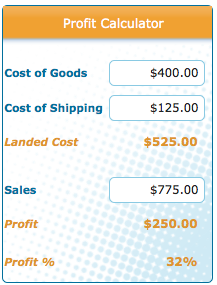
Example A
In this scenario for example, the cost of the goods was $400.
The cost of shipping the goods was $125.
The estimated sales revenue from this purchase was $775. (This is either based on an estimation or the actual amount you sold).
The widget automatically calculates and returns your landed cost (Goods + Shipping - $400 + $125 = $525), Profit (Sales - Landed Cost = Profit) and your Profit Margin (Profit / Sales).
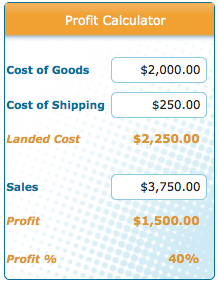
Example B
In this scenario, the cost of the goods was $2,000.
The cost of shipping the goods was $250.
The estimated sales revenue from this purchase was $3,750. (This is either based on an estimation or the actual amount you sold).
The widget automatically calculates and returns your landed cost (Goods + Shipping - $2,000 + $250 = $2,250), Profit (Sales - Landed Cost = Profit) and your Profit Margin (Profit / Sales).
|
Cost of Goods
|
|
|---|---|
|
Cost of Shipping
|
|
| Landed Cost | |
|
Sales
|
|
| Profit | |
| Profit % | |
|
|
|
The potential revenue calculator can be used to estimate the potential return you can expect on a customer return load.
In its simplest form, you will estimate the percentage of the value of the goods that you will be able to sell. As a second step, you will estimate what you believe you can sell the goods for as a percentage of their value.
|
Retail or Wholesale Value
|
|
|---|---|
|
% Sellable
|
|
|
Your Selling Price
(as a % of value)
|
|
| Your potential Return | |
|
|
|
The graded potential profit calculator is a more complex widget that can assist you in estimating your potential returns on a customer return load. This widget is to be used by more experienced buyers who have worked with these types of customer return loads in the past and know more or less what constitutes different grades of products based on condition and category.
The widget is flexible and allows you to “grade” a load by various factors and estimate your potential return based on each factor. The most common way to segment and grade a load is either by Product Category or by Condition.
You can either grade/segment the load by category: Premium electronics, clothing, kitchen appliances, toys, food, etc. Or you can grade it by condition: 100% New; Like New; Out of Box; Defective, etc.
The Customer Return Profit Calculator assumes % of the load as a % of the value fo the load. It is not referring to % of Load in terms of QTY but in terms of Value. E.g. If your total load is $1,000 in value and includes 1 TV for $800 and 4 Radio’s for $50 each and the TV is sellable but the Radios are all unsellable – then the % of sellable value would be 80% in that case.
| Retail or WholeSale Value | |||||
|---|---|---|---|---|---|
|
|
Selling Price (% of Value) |
|
||
| Selling Price (% of Value) |
|||||
| Selling Price (% of Value) |
|||||
| Selling Price (% of Value) |
|||||
|
|
|||||
|
|
|||||
| Total % – |
Your potential Return | ||||
|
|
|||||
The Liquidation Load Profit Estimator combines several widgets into one, taking into account your landed cost and allowing you to calculate your estimated profits using either the Simple Calculation or a Graded calculation.
To begin – simply enter the total retail or wholesale value of the load, as well as what % you paid for the load. Enter the shipping cost (if applicable) in the Shipping field to calculate your Landed Cost. The widget will automatically calculate your Landed Cost.
If using the Simple Calculation – you will prompted to enter the % of the Load that is in Decent Salable Condition, and the % of the Load that is in poor or unsalable condition. You can then enter the % of wholesale or retail value you either estimate to receive or have already received for these items.
The widget is flexible and allows you to “grade” a load by various factors and estimate your potential return based on each factor. The most common way to segment and grade a load is either by Product Category or by Condition. You can either grade/segment the load by category: Premium electronics, clothing, kitchen appliances, toys, food, etc. Or you can grade it by condition: 100% New; Like New; Out of Box; Defective, etc.
The Liquidation Load Profit Calculator assumes % of the load in terms of $ value. It is not referring to % of Load in terms of quantity, but in terms of Value. For example, if your total load is $1,000 in value and includes 1 TV that has a value of $800 and 4 Radios that have a value of $50 each and the TV is salable but the radios are all unsalable, then the % of salable value would be 80% in that case.
|
|